Dune: Part II exceeded my expectations and, like the first installment released in 2021 (which I also reviewed), deserves to be ranked among iconic science-fiction movies including 2001: A Space Odyssey, Alien, Star Wars, and Blade Runner. I think the simplest way to summarize my feelings is that whichever way one screens it, be it at a theater or streaming via a MAX subscription at home, it is worth whatever price you will be charged… but I must emphasize that if you have the ability, this must be seen in a theater because going to the cinema is an experience that further enriches whatever movie you are viewing.
Having never read the novels by Frank Herbert (save for the first chapter involving Paul placing his hand inside the box of death… I need to work on my attention-span for reading), I am unable to commend the faithfulness of these adaptations on my own merit. However, I saw both films with my brother and his best friend (both of whom are major fans of the original novels), and I spent the next two hours afterwards observing them rave about their vindication of both films. So, by way of proxy, I can confirm that this installment is worth seeing for anyone who read the books.
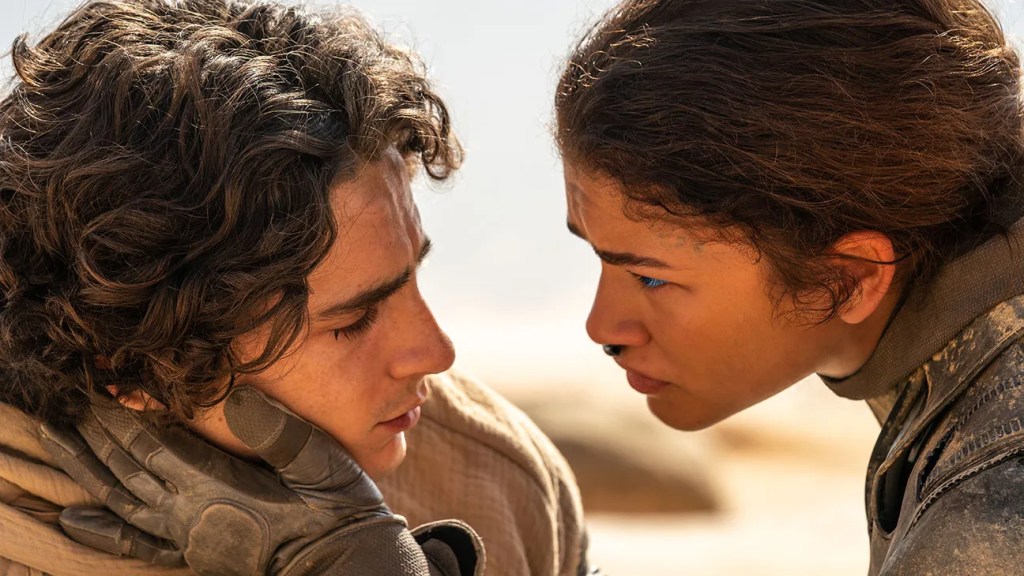
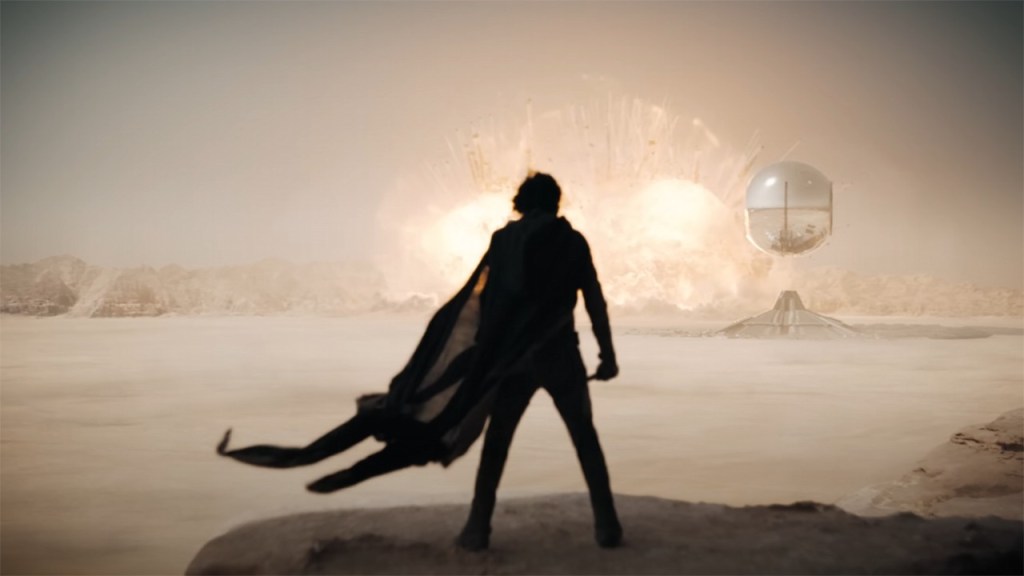
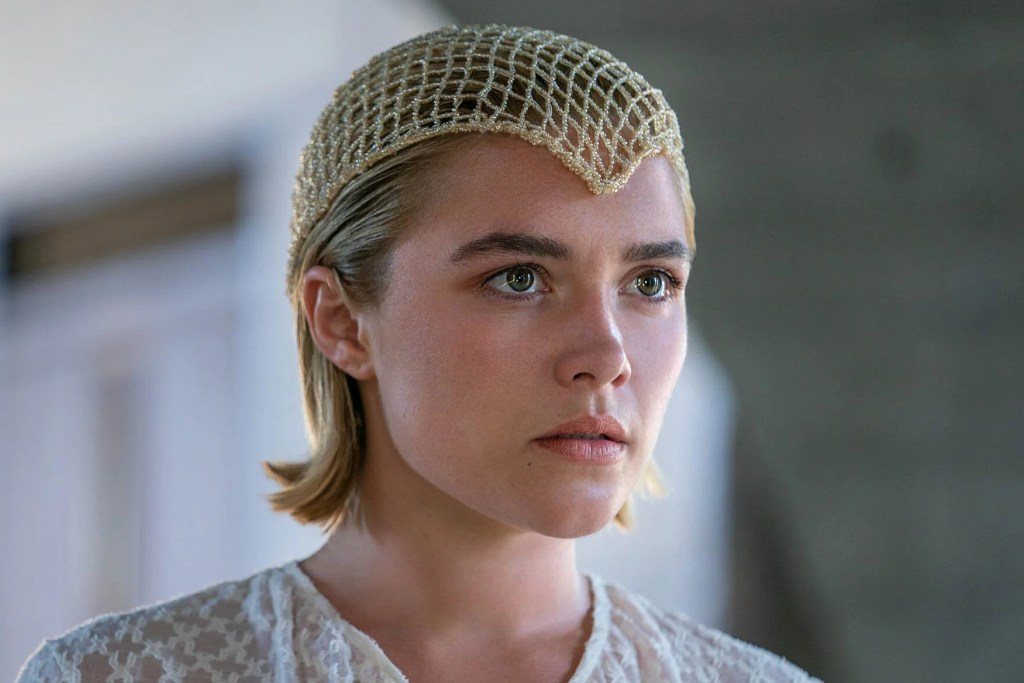
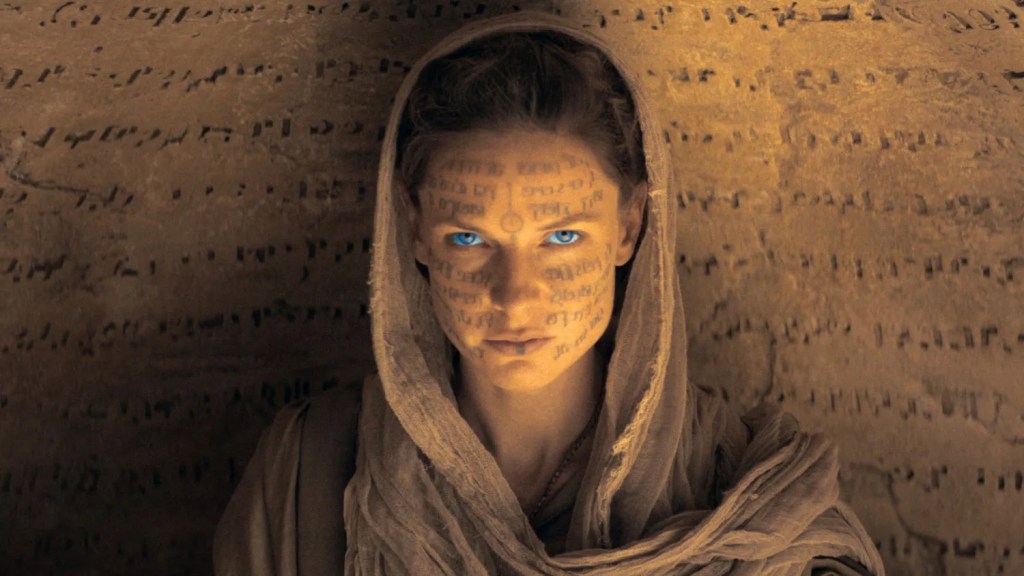
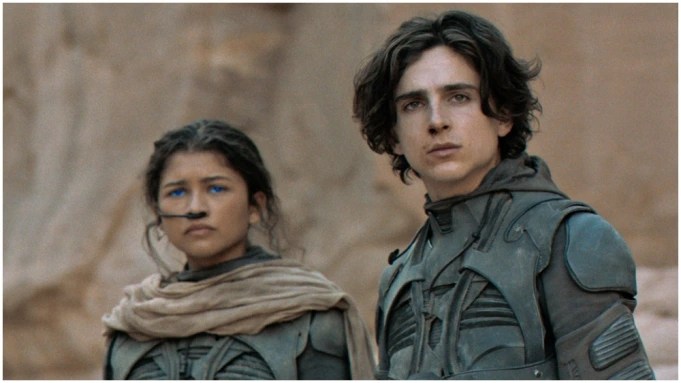
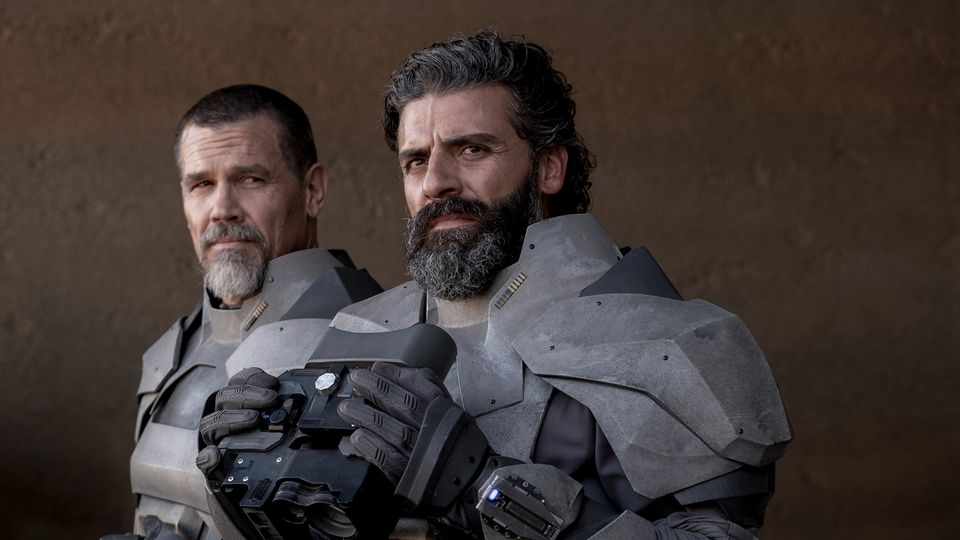
Dune delivers in every way imaginable. What struck me most was the cinematography, particularly with the depiction of colors through the rays of sun on the desert planet Arrakis. Sound plays a major role, too, such as the pulse vibrations placed in the sand used to conjure the dangerous sandworms. And we cannot omit anyone’s performances in this star-studded cast, led by Timothée Chalamet, Zendaya, Rebecca Ferguson, Stellan Skarsgård, Javier Bardem and Josh Brolin (always interesting to see these real-life friends as co-stars again, considering their first film involved Bardem hunting Brolin across the Texas desert in No Country for Old Men); in addition to new cast members including Austin Butler, Lea Seydoux, Florence Pugh, and Christopher Walken. I do not think it would take much persuasion for studio executives to greenlight raising the salary cap to include more A-listers such as Leonardo DiCaprio, Brad Pitt, or Tom Cruise.
What I most appreciate about this form of storytelling is learning about this setting through casual background noise with subtlety. It can be quite a turnoff when filmmakers attempt to reveal important story pieces when the unnatural dialogue makes it seem like they are proselytizing the narrative. The sign of a good science-fiction movie is when we can suspend our disbelief and accept the science that is presented to us, regardless of whether we have a degree in physics or are simply science-savvy, particularly when it comes to the technology the characters use (be it transportation or weapons). I can only hope that it won over Neil deGrasse Tyson, who has built a reputation for ruining nearly any movie for the scientific inaccuracies (especially when he remarked that the star constellations were wrong in Titanic).
But, above all, we cannot neglect the narrative and characters. Filmmakers can use the best production value available and wow everyone with the special effects, but it is utterly useless if the story and the characters are garbage. The politics embedded in this narrative recalls the drama of ancient Roman history as people calculate their moves to how leaders will be cast down and others will rise to replace them, whether they are virtuous or not… but lacking virtue always makes a character far more interesting (just ask Vincent Price about his preference for playing villains).
Dune has rightfully earned its place among our watercooler conversations as one of must-see movies of the year. If you are generally not a fan of science-fiction movies, I promise you that this is worth your attention. Movies that fire off all cylinders only come around every blue moon are always worth seeing, regardless of the genre and themes. Again, whatever price the theater charges for your ticket, it is worth every penny.
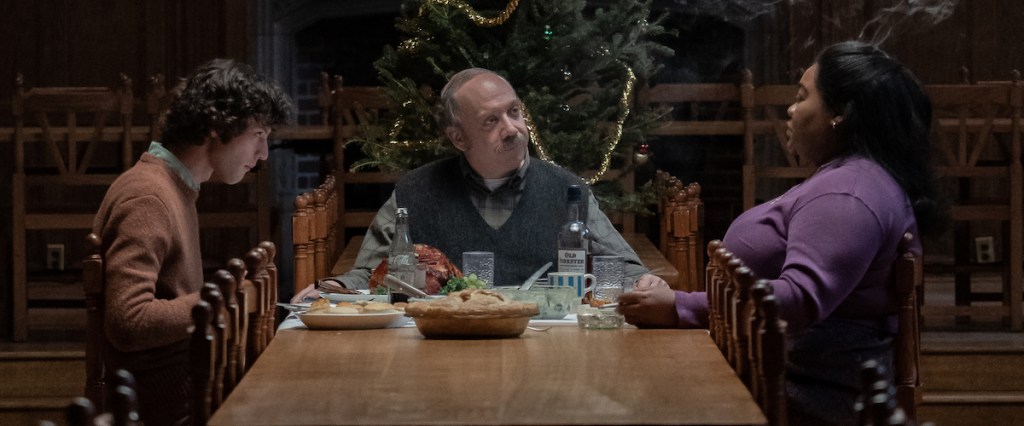
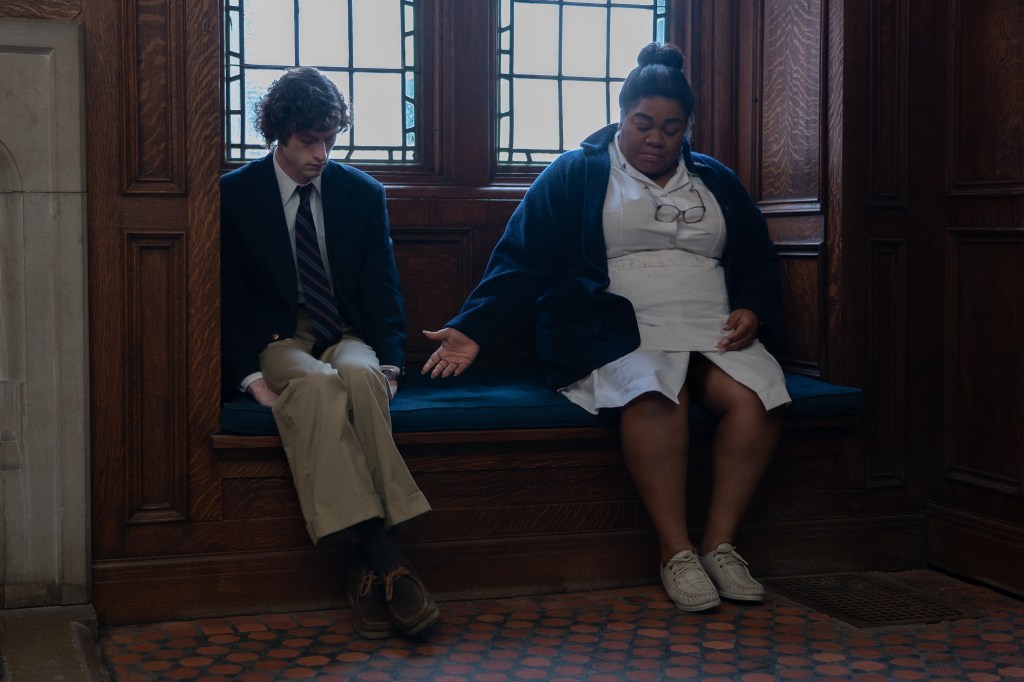
The Holdovers is a must-see, there is no other way to describe it. Paul Giamatti delivers alongside Da’Vine Joy Randolph and newcomer Dominic Sessa (who is certain to have an extensive career with this debut) in Alexander Payne’s newest film depicting the in-between period of life on campus for a boarding school during Christmas break.
This film struck a personal note with me. Though I never attended boarding school (why should one pay the equivalent of a college tuition for a high school diploma?), I attended Xavier High School, which was all-boys (like the fictional Barton Academy in the film), feeling a rush of nostalgia as I watched the students clash amongst each other (ah, the first rushes of testosterone). It was the setting the first drew me in, as it was something I could relate to (one of the many ways that art finds a way to touch us individually), especially as I recalled Dead Poets Society and Scent of a Woman. I can confidently say that The Holdovers belongs along their ranks.
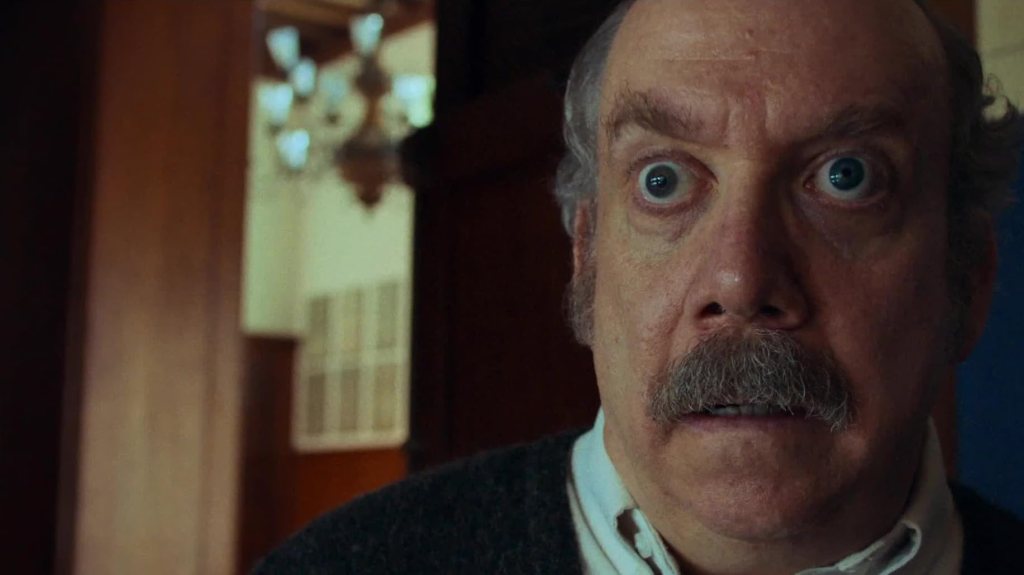
Set in December 1970, The Holdovers depicts Paul Giamatti as Paul Hunham, a teacher of classics at the fictional Barton Academy who is disliked by both the students and faculty for his dry, sarcastic, cynical, and merciless approach to teaching the spoiled children of immensely wealthy and powerful figures. Da’Vine Joy Randolph is Mary Lamb, Barton’s cafeteria manager who is grieving the loss of her son, Curtis (also a Barton alumnus, but was recently killed in Vietnam as they could not afford tuition for college deferment). Amongst the elite, Mary, a Black woman, represents the inequality in society (which possibly led to the students’ wealth). Despite her lowly position in the school, she possesses empathy for the students while also being able to wield authority over them, perhaps the result of wisdom, best described as “knowledge from scars”. Sessa’s portrayal of Angus Tully, a frustrated student who has been neglected by his mother, perfectly encapsulates, not just teen angst, but sorrow and hope, in addition an earlier sense of empathy for others (even if he needs to learn the hard way but is quick to change).
All characters are exceptionally layered. Throughout the movie, we learn the comprehensive foundation of Paul, Mary, and Angus (in addition to the secondary characters). One leaves the theater feeling as though they have known said characters for many years. If Giamatti is not nominated for an Oscar this season, it will just be another count of the awards being shows and parties for entertainment’s elite. Although cantankerous, Giamatti portrays Hunham in a lovable antihero manner (particularly his ability to cleverly reference historic persons and events to insult others).
I also need to give kudos to the cinematography which has the rustic touch of 1970s nostalgia. But the writing: it allcomes back to the writing. World events intertwine into the story to reinforce the era. Cliches are evident, but it was the ability to subtly to pick up on the characters and their personalities that impressed me, akin to watching a stage play as we learn about prior events that took place off-stage.
My only complaint, though, was that Mary, a main character, did not have a fulfilling resolution weaved into the stories of Paul and Angus. But apart from that, I tell readers that The Holdovers is a must-see and is worth the potentially high price of a ticket.
I just learned that this week marks the thirtieth anniversary of the Power Rangers franchise with the premiere of Mighty Morphin Power Rangers on Fox Kids August 28, 1993. It was a staple for my generation’s childhood. Should any kids ask any adult about Power Rangers, they will experience a release of nostalgia they did not yet know was possible.
I have written numerous articles about movies and shows that have always been special to me, so one should anticipate this to be an article about me memorizing every line to every episode and all the merchandise I owned, right?
Well, that is not the case, here. I did not have Power Rangers in my childhood because my mom thought it was inappropriate because of the violence.
Now the reader must think I’m going to pen an essay unleashing the decades worth of anger I had repressed towards my mom for depriving me of a proper childhood and fitting in with my peers.
The reader is wrong again. As the title of this piece implies: I’m grateful for my mom withholding the franchise from me. There is more to this story. While she prohibited me from watching Power Rangers, she had no problem driving me to the video store (a bygone era) to rent the Indiana Jones movies, which contain fighting Nazis. Not only is there violence, but it opens the door to discussions about the Holocaust! In following my mom’s logic, Indiana Jones ought to be banned in our house.
However, I think there was something more to that. The Indiana Jones franchise is a staple of cinema and American culture. Power Rangers is a kids show with cheap special effects and kooky makeup. I remember hanging out with friends in college who decided to rewatch old episodes. I, having never seen it through the eyes of childhood, could only critique it as an adult, easily dismissing it.
I consider this experience to be special because it comes back to my mom prioritizing exposing my brothers and me to quality entertainment from an early age… even if it was not age appropriate. Not long after that, I was watching Jurassic Park at age six, as I properly understood that it was all pretend, thanks to my mom’s explanations. At the age of ten, I received Ferris Bueller’s Day Off on VHS for Christmas after Mom showed it to me on TV. That spring, she bought the family one of our first DVD’s: Top Gun. That summer, she bought the soundtrack to the musical adaptation of The Producers (which was riddled with social satire that only Mel Brooks can get away with). That fall, we were watching Young Frankenstein. A couple of years later, my mom showed me Rain Man on TV. Eventually she and my dad agreed to show us a HEAVILY CENSORED version of Animal House (don’t worry, my parents knew where to draw the line).
It’s safe to say that my introduction to quality entertainment came from none other than my mom. Most people do not begin to appreciate the classics until they get to high school or college. My mom started me off on the right path early. Not only did she give me an appreciation for culture, but she introduced me to behind-the-scenes stories that contextualize the movies and make you enjoy them even more.
But we do have our disagreements. One of the most controversial decision in the history of the Oscars was handing Best Director and Picture to Kevin Costner for Dances With Wolves over Martin Scorsese for Goodfellas. I side with Goodfellas, she sides with Dances With Wolves. I love diving into iconic black and white classics and even silent movies, my mom seldom watches an old movie. My mom is not a fan of vulgarity and violence on the screen, as a result she dislikes Quentin Tarantino, whom I hold in high regard. And above all, while she watched and appreciated the Star Wars trilogy when it was released, she gave birth to a fanboy of the franchise.
Regardless of these disagreements in entertainment, I owe my mom so much for exposing me to these iconic movies at an early age. She introduced me to Spielberg, who is the gateway to movies as an art, cinema, for the masses. I always make sure to thank my mom for all that she’s done for me over the years (properly my brothers and me before herself), but I also thank her for introducing me to the classics, cutting the line ahead of my classmates who would discover these joys later on.
There is nothing groundbreaking about Dune (think special effects or storytelling). But every technique invoked was done in the proper manner. I was beyond satisfied with every choice made in production. Cinematography, music, acting, editing… it was all done right.
I cannot emphasize enough of how pleased I was with this adaptation of Frank Herbert’s 1965 sci-fi novel. While I had not read the book (beyond the first two chapters), friends raved about the adaptation being everything they could ask for.
I also had not screened the 1984 adaptation helmed by David Lynch, but I was aware of its poor reception. This is not intended to be a single film, as the novel was the first in a series, and we saw no sequel to Lynch’s version, which should tell us everything we need to know about its quality. However, director David Vellineveu (whose previous films include Arrival and Blade Runner 2049) has delivered a film that makes us eagerly await its next installments. I would say it is the equivalent of a perfectly pitched TV pilot.
Perhaps what I was most impressed by was the explanations for intricate details and rules for this universe without breaking the fourth wall. It was as if we were conveniently learning everything in preparation for future events without making it obvious and cringeworthy. There is also the establishment of Zendaya’s character. Although her formal performances are reserved for the end of the movie, she appears through interwoven vignettes throughout the film, conveying her importance.
I cannot review any further without giving away spoilers, even in the slightest manner (I know many people who would react to a minor revelation in a manner equivalent to Frank Costanza on Seinfeld: “I like to go in fresh!”)
In short, the ticket is worth every penny and the trip to the theater is worth every second spent away from home.
After more than a year of abstaining from movie theaters, as well as keeping up with new releases (since we were all so incredibly overwhelmed by the tumultuous year that was 2020), I was finally able to screen a new movie in the manner that of how this medium was originally intended: on the big screen, sitting among strangers. I can say unequivocally that it was good to be back!
The Green Knight is unlike any other fantasy adaptation that I have screened throughout my life. Abandoning the traditional methods used for films among the likes of Harry Potter, The Wizard of Oz, or The Lord of the Rings, the film takes an unnatural approach through unusual cinematography and editing (perhaps to best emphasize the surrealism of medieval legends), akin to the films of Paul Thomas Anderson, Terrence Malick, or the newly recognized Ari Aster (Heredity and Midsommer). While this film is a fantasy in terms of setting and events, it also blends a thought-provoking arthouse air with what is presented.
I will be completely forthcoming and share that I did not understand many aspects of this movie. Despite this, I will hail it as fantastic. Why? Because it reminds me of the genre usually produced by the artists I previously mentioned. And like the works of Anderson, Malick, and Aster, I anticipate an analysis to be made available, and I will gain a further appreciation for this piece.
This is not an entirely faithful adaptation of the legend of Sir Gawain and the Green Knight (rarely can one adapt one medium while retaining every aspect of its source material). However, there are many instances in which those behind the movie were able to adapt the original poetic dialogue of the epic in a manner fitting for a motion picture, the lines able to convey the grandness of the subject at hand. To be fair, the only way I was able to notice these differences were by looking up the summary of the original epic, the last time I read it was during my British literature class senior year of high school (okay, I was assigned it and just listened to my teacher and classmates discuss it. I’m sure I’m not the only one who has done that).
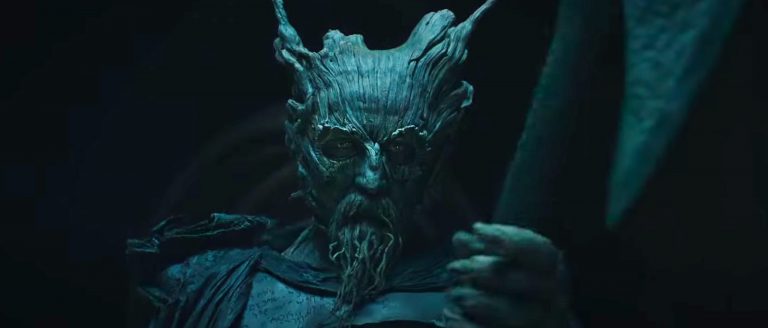
For me, the greatest satisfaction came in the depiction of the title character, the Green Knight. Going back to my high school years, if this story ever came to mind, I would wonder how this character would be portrayed. How would he be green? What would give him the recognition and terror that was woven into his identity? Enter a man who appears to be a hybrid between human and tree, and a bellowing English countryside voice (provided by Ralph Ineson). The Knight requires an appearance that would make him inhuman and terrifying. How else could we justify a character who, upon challenging Gawain and the rest of King Arthur’s court to chop off his head, was able to arise and carry said head off with him? (Not a complete spoiler, as this is the central driving plot of the original epic poem)
In short, I urge everyone who appreciates the fantasy and arthouse genre to see The Green Knight. Above all, I urge all of us to search for an analysis of the movie that will give us a greater appreciation. While many pieces of art embrace what appear to be bizarre and nonsensical (think Queen’s Bohemian Rhapsody), a proper walkthrough can make us fall in love with the unusual.
This review is late, but I am determined to publish it, as I am eager to share my reflections with the world.
Pixar has done it again: a masterpiece of an emotional rollercoaster (the good kind).
Their newest release, Soul, follows the story of Joe (Jamie Foxx), an ambitious musician who, through a simple accident, passes towards the great beyond. Desperate to avoid the afterlife get back to his affairs on Earth, Joe poses as an “instructor” for new souls ready to begin life, and is assigned soul 22 (Tina Fey), who is procrastinating her next step through her annoying cynicism (having already irked her previous instructors, among whom are Carl Jung, Mother Teresa, and Nicolaus Copernicus). Each soul needs to find their “spark”, which will guide and shape their lives. Seeing as 22 has no intention of reaching life, Joe seeks to exploit his assignment to get himself back on Earth through a loophole, which 22 agrees to with enthusiastic indifference.
As you watch the movie, the story appears to have a predictable formula. However, Soul manages to tackle this formula in a profound and touching manner, as Pixar has always done. Soul explores the notion of the meaning of life, our vocations, and satisfaction. They emphasize savoring the little moments that we have grown accustomed to, I lesson I have learned years ago and have zealously pursued ever since. Perhaps this is the main reason why I loved the movie: in order to share this philosophy that has guided me through good times and bad.
My other reason reason for loving this movie is the animation. It is traditional Pixar computer-generation, but it appears to be improving with each release. The detail in the lighting makes the scenery appear realistic, even with their unrealistic designs. And then there is the movie’s take on the before/afterlife, and breaking time’s confinements.
Since the Covid-19 pandemic has cancelled practically all forms of socializing, movie releases have skipped the theaters and gone directly to immediate access; in this instance Disney+. If you have your own account, I urge you to screen this flick as soon as you get a chance! If not, simply pull your debit card out of your wallet and pay a whopping $6.99 per month subscription, then get to watching. After all, what else can you do, even as the pandemic appears to be winding down?
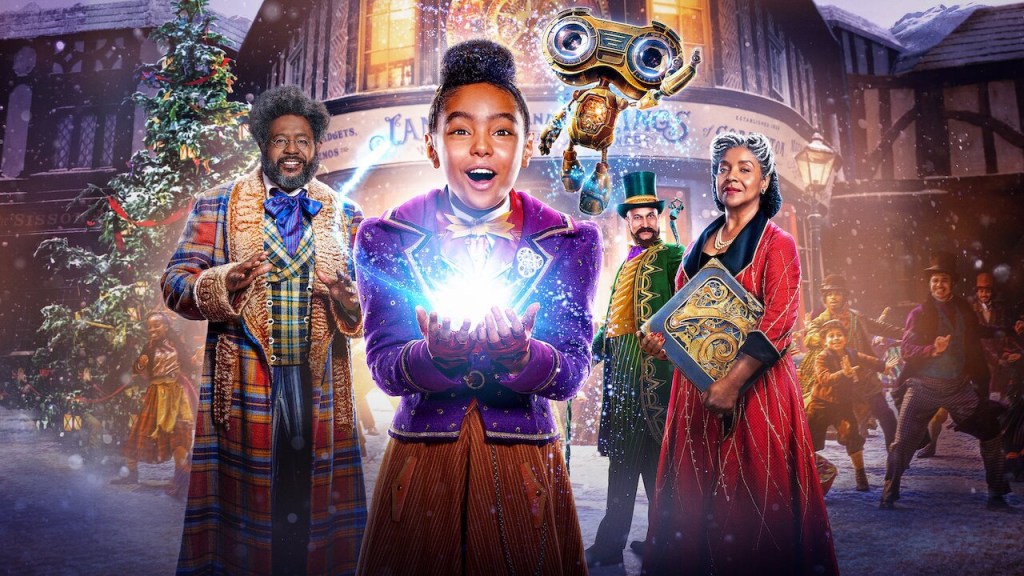
While Jingle Jangle provides spectacular visual effects, catchy songs, and lovable characters, I fear it will go down in film history as only a cult classic that is adequate at best.
The reason for this being just another Christmas film is the plot: Journey Jangle, granddaughter of legendary toymaker/inventor Jeronicus Jangle, seeks to restore faith in her grandfather who has become disenchanted after his apprentice Gustafson had stolen his ideas decades earlier. This is a recycled plot that has been used on a myriad of productions over the years. I could see each detail coming around its respective corner.
For the most part, the casting was great, except for one character: our antagonist, Gustafson, played by legendary comedian Keegan-Michael Key. Because Key has left such a wonderful impression as a goofy comedian, it was difficult for me to accept him portraying a driven villain. While there are plenty of comedians who have triumphed in dramatic roles (think Robin Williams and Peter Sellers), I do not believe this is the role for which he will achieve that feat.
Don’t get me wrong: I enjoyed watching this flick, and I am sure that there are many who will want to screen it again each holiday season, but I have learned there is a clear difference between enjoying a movie, which is based in reaction, and praising it, which is rooted in artistic criticism. I elaborated on this in one of my earlier reviews for Hubie Halloween. Years from now, critics will not lump it together with other Christmas classics such as It’s a Wonderful Life, A Christmas Story, Elf, Home Alone, or even Die Hard.
For those seeking simple entertainment, indulge! For those seeking something bigger, look elsewhere.
As somebody who looks for originality in nearly every aspect of life, I go into Christmas movies with a great deal of hesitation. Should anybody seek a Christmas-themed movie with an original take, The Christmas Chronicles 2 does not deliver, even for a sequel. With an abundance of unoriginal rehashed story-elements, there are plenty of cringe-worthy cheesy moments to go around.
I originally looked forward to this installment, thinking it would be a flick that would be enjoyable in the end. That is, until I started watching it.
The movie depicts a disenchanted former elf named Belsnickel (played by Julian Dennison) is hellbent on destroying Christmas, and once he appears to have the upper hand, our hero from the first Christmas Chronicles, Kate Pierce, must rise to the occasion again to save the holiday (one can already groan upon reading these details).
Kurt Russell reprises his role of Santa Claus in the same manner as he did with the first installment. He defies the traditional depiction of St. Nick: overweight and jolly. In these movies, the one visual detraction is his size, no longer overweight, but a slim and fit figure. He also is not happy and jolly, but rather a stud; bringing the cool vibes from Russell’s career defining action movies. However, he delivers the affectionate and caring Father Christmas traits that we would want in any actor depicting the man we put our hopes in as little children.
However, the performance of Mrs. Claus (played by Russell’s real-life partner Goldie Hawn) does not deliver, appearing to lack the enthusiasm required for such a role. Russell’s run as Santa is probably the sole redeeming quality of this picture, in my opinion.
There are several appeasing action moments, usually involving Santa’s sled, but not every moment is spared of the cheesiness (mainly seen in a sequence involving fighting off elves with a nerf gun). But I will concede there is a heartwarming moment, or two.
Perhaps I am not taking into account that I am a cinephile and am not the target audience (likely young families)? But I am writing on behalf of all who seek a good movie, and there are moments when we will get excited when a child asks to watch a certain movie with them, and there are plenty of family-oriented movies that us adults will watch on our own initiative. But for The Christmas Chronicles 2, all I can say is that it merits an “Eh, it’s the holiday season and I need to pass the time.”
What I am about to share with the world (or at least to my few followers) is a writing project that I have had on my mind since I was a teenager. It has been stewing in my mind for over a decade, and I hope that by sharing key plot summaries and a character analysis or two, I can get the feedback and inspiration to go forward in my attempt to bring this story onto a bigger platform.
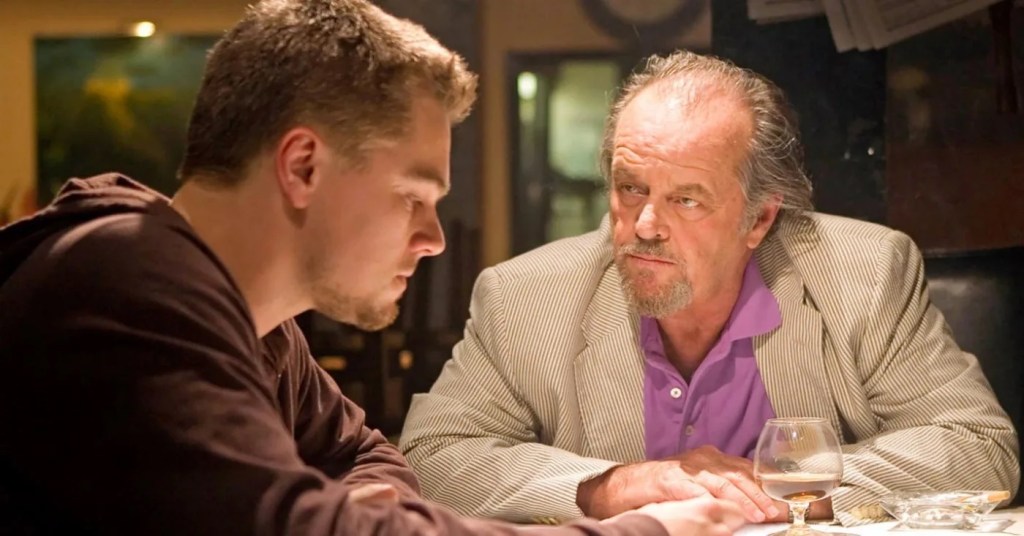
In the Fall of 2006, I was anxious to see Martin Scorsese’s new film, The Departed. My motivations were rooted in a trifecta:
1. It was set in Boston.
2. It involved the Irish mob (as I felt that the mafia/organized crime was under the monopoly of the Italians)
3. They included music by the Dropkick Murphys in their soundtrack (I first discovered them a few years earlier through my love of the Red Sox, and now they were prominently featured in an A-list movie).
While I was not able to see the movie until March of the following year, I could not help but yearn for more movies like this. I simply wanted to see more movies released that fell within this genre: Irish mob movies set in Boston (little did I know that this was already a fertile market to begin with). I knew I wanted to be a writer, but at that point I wanted to be a sports journalist, so I figured I would bang out a plot in a notebook for now and eventually hand it off to a novelist or screenwriter that I would meet in the future, and they would finish it for me.
But the next summer, I decided to get to work on it. Why not elaborate on everything? Why not go forward and see what I could do with it? And the next year as I started my senior year of high school, I got a MacBook, and because I was already a miserable student who could rule out attending a reputable college, I simply wrote what had been on my mind for the last two years as my teachers went on about God-knows-what. I ended up writing a 120+ page manuscript (Times New Roman font, size 12), and the following spring, I banged out a screenplay adaptation.
But over the course of the last 11 years, I’ve done practically nothing with it. And I was discouraged after I sent a copy to a family friend who gave me a scathing review of it, which made me realize I had to start over and rework everything. I have given attention to a few scenes that I believe could add more to the plot and character development, but apart from that I have done nothing. You would think that I would have banged it all out considering that I worked jobs in the last two years that require little attention on my part and I could just get it all done in a heartbeat. But no, that’s the problem with the internet, there are way too many distractions (this is only exacerbated by having a reality TV star turn Washington, DC, into a reality TV show, and I found myself constantly paying attention to whatever drama took place that day).
Thankfully, you-know-who has been voted out of office, and if the transition goes according to plan (which I’m sure it will, as his voter fraud accusations are being tossed out by every court they are brought to), I can pay more attention to my creative work and try to make a career for myself beyond sitting at a concierge desk making just above minimum-wage.
Perhaps the proper motivation will come from sharing it with the world for the first time beyond handing copies of a draft to classmates and friends? Perhaps through grassroots social media posts, I can get people interested, which will give me the incentive to pound out the draft in order to finally share it with the world? If so, then let’s get started!
THE PLOT
The story revolves around Seamus Mahoney. Not pronounced Mah-hoe-nee… Mah-hunny (I found out through Irish friends that we Americans had butchered the pronunciation of the name, even my own family, as it is my grandmother’s maiden name). Seamus is a psychiatric intern with Massachusetts General Hospital with a dark family history.
When his Irish parents, Bill and Molly, arrived in Boston while his mother was pregnant with him, they did not have the ability to make ends meet to support their imminent new addition to the family, on top of his toddler older brother, Darragh. After working numerous dead-end jobs, Bill was recruited by Charles Myers to do work for the infamous Black Higgins Clan, a gang run by the notorious Mike Higgins, who made Whitey Bulger look like a mere schoolyard bully.
Once Bill was able to rake in enough cash, he bought his own bar that he and Molly would run. Their dirty money filled them with shame, and they did all they could to make sure their sons never got into trouble of any kind. But the Clan would never escape them, and it lingered in their lives like a shadow, following them throughout their childhood.
As Seamus turned to a respectable medical career, he met Emily Hawke, a fellow intern from England, and they soon fell in love and were engaged to be married (and the family had a great deal of fun pointing out their engagement’s ironic overlooking of historic conflict between the English and the Irish.
But the fun would not last, as Myers informed Bill that an old-fashioned gang from England was gaining international territory in Boston with an anti-Irish approach. They learned this gang had bought out a former Clan member who provided them with information about all who worked for them, past and present, with the intention of bumping off Higgins and his associates. Also, they know about Seamus and Emily’s impending marriage, and will do whatever it takes to make sure it does not happen.
In a sudden move, Seamus and Darragh are attacked by the gang, and only Seamus survives. Already wracked with survivor’s guilt, he is pushed over the edge when the police close the case. Desperate for justice, he defies his parents’ efforts to keep him on the straight and narrow and secretly joins the Clan as a way to navigate the criminal underworld and find the gang responsible for his family’s misery.
Along the way, Higgins will push Seamus to his limits, challenging him to re-examine his life and all he holds near and dear; from his relationships with his parents, Emily, to his faith in God, himself.
THEMES
Perhaps the most obvious theme that has stuck with this story from the beginning is TRUST. Seamus was raised with a strict sense of right and wrong instilled by his parents, ashamed of their mistakes. He will have to reconcile his love for his parents and Emily as he defies them and does everything to satisfy his thirst for justice.
Higgins will act as an antichrist figure, in that he is opposed to Jesus Christ. He will instruct Seamus in his worldview rooted in the Sermon on the Mount. Christ commands the world to recognize good and evil, and to not even settle for even a seed of evil; to strive to be perfect. There is no room for settling. Turning the other cheek and going the extra mile is to dare wrongdoers to either follow through in their evil or renounce it. As far as Higgins is concerned, Seamus cannot lie to himself in thinking that he is still a good man while he indulges in acts of evil. He can either obey his reason by being a saint and yearning for peaceful justice, or give in to his anger and lust-driven search for instant satisfaction.
And finally, the other major theme is HATE. I did not realize until recently that the last few years have been a perfect time for me to go through with writing this project. We are finishing the presidency of Donald Trump, who started his whole political career in a racist-driven conspiracy that Barack Obama could not have been born in the United States, along with countless other remarks rooted in bigotry. I have marveled over the years that as a youngster who had not seen a black president, yet, that by the time this historic achievement rolled around that hate and racism would be a thing of the past. But we have observed that no matter how much progress we believe we have made as a society, hate endures. This is the underlying tone of how an English gang is holding to old-fashioned anti-Irish bigotry in the 21st century.
There will also be a focus on the presence of organized crime in South Boston, even as the area is overwhelmed with gentrification and poverty seems to be disappearing. Again, no matter how much progress society has made, evil and sin remain.
So hopefully getting this out into the world with even the smallest audience can give me the incentive to hit the keyboard to finish this project after so many years. Godspeed to me!
If I were to inquire among the public what they consider to be one of the scariest films ever made, I would hear countless familiar titles: The Exorcist, Alien, Jaws, The Shining, The Silence of the Lambs… each one terrifying in its own manner. But there is one horror film that will linger in the viewer’s mind well after completing it, and it lacks a reputation akin to the films I listed above, which it truly deserves. This movie is 1980’s The Changeling. I discovered it many Octobers ago when I was seeking a list of new scares for Halloween season and came across a list of scariest horror movies compiled by Martin Scorsese, who listed it as among his top eleven terrifying movies. To my luck, I found that it was easily accessible on YouTube in its entirety. And to my surprise, it was the first movie to scare me in years. I had watched countless horror flicks as a teenager and college student, but I was always unfazed, as I was aware they were simply movies. This brought me back into the world of genuinely believing whatever I saw before me, as if it were happening to me.
George C. Scott stars as John Russell, a composer who relocates across the country for an academic career after his wife and daughter are killed in a road accident. Needing a place to live, he is hooked up with a home by the local historic society that once belonged to an influential local family. Upon moving in, Russell is harassed by the poltergeist of a young child, who seeks justice from beyond the grave.
The Changeling can be summarized in one word: creepy. The supernatural root comes from the ghost of a child who perished during the Progressive Era of our nation’s history, which, in my opinion, is the creepiest timespan in our history. Just looking at the black-and-white portraits that depict people not smiling (as early cameras took greater lengths of time to take pictures, try holding a smile for nearly a minute), in addition to the fashion that was in style back then. This goes on top of taking child-friendly themes that tend to border on creepiness to begin with. It is perfect fertility for a ghost story.
Its horror is unique compared the movies I listed in the beginning of this essay, which tap into our fight-or-flight instincts (likely flight for most of us). The fear in those films is driven by survival instincts, whereas this film involves cooperation with a being that we cannot see. Val Lewton pioneered the idea in filmmaking that it is not what we see that scares us, but what what we cannot see, and we are constantly terrified following an occurrence that we experience every day that was caused by something from the great beyond.
There is a sense of mystery, as Russell seeks to uncover the identity of the ghost and why it is haunting him, which leads him on an investigative trail that uncovers a scandal that had been buried for decades, which blends the feel of films akin to All the President’s Men, Spotlight, and Erin Brockovich.
The YouTube link will be included at the bottom of this review, and I implore every reader to watch it when they have a chance during the remaining two weeks of October. You will not be disappointed. Trust me. It even has the approval of Stephen King, and that should be the ultimate authority to persuade you to sit down and have a good scare.











 The City of Cinema