For the last fifteen years of my life as a lover of movies, there is only one character who has haunted my mind. His story is an epic, not in the traditional manner of conquest, but his growth as a human being. Driven first by profit, he eventually squanders his long-desired fortune to save the lives of over a thousand people he was initially apathetic to. This is Oskar Schindler, the hero of Steven Spielberg’s 1993 masterpiece Holocaust drama Schindler’s List, who reminds us that the light shines on in the darkness.
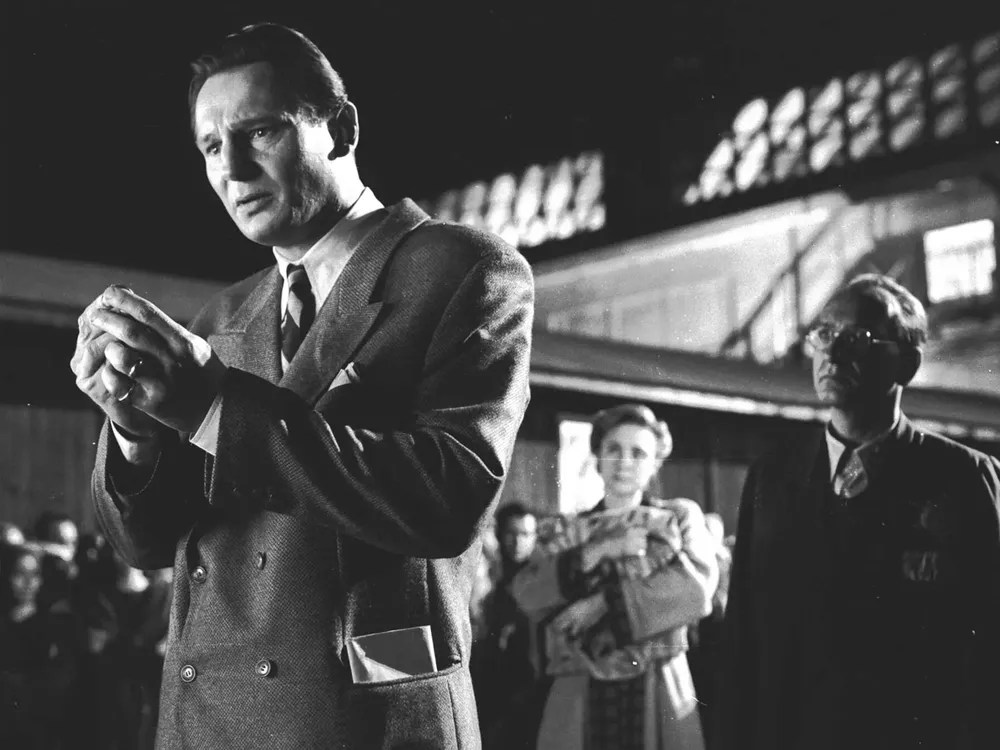
His introduction depicts him making friends with local Nazi leaders just after the invasion of Poland, but this is strictly for the purpose of networking. During his first scene with Itzhak Stern (Ben Kinglsey), a Jewish accountant living in the Kraków Ghetto, Schindler brushes off Stern making his legal disclaimer of informing him that he is Jewish, making it clear that he does not believe in the Nazi master race ideology. Despite his rejection of hate, he is still morally flawed as he pursues his lusts and ambition. Being a good man requires far more than rejecting prejudice, because it is an easy and low bar to clear. There were plenty of other good people who rejected the hate of the Nazis, Spielberg could easily have made a movie about any one of them. So why Oskar Schindler?
Because Schindler’s moral flaws make him more interesting than someone who opposed the Nazis from the get-go, stood their ground, and never looked back.
The transformation makes his character arc far more beautiful. Initially apathetic to the plight of the Jews, his final scene depicts him sobbing as he laments that he was not able to save more from genocide, despite dwindling all his resources. The duration of the movie attempts to explain how he could make such a transformation. It may very well be the case that the historic Schindler does not line up with Spielberg’s depiction of the man. But in the context of the art of cinema, I am obliged to commend Spielberg. Again, this epic is the transformation in which the man learns to listen to his heart when he is surrounded by the clearest depiction of evil in human history.
He is one of the most comprehensive characters in all of movies. Spielberg likened him to Rosebud, the sled owned by Orson Welles’ character in Citizen Kane (spoiler alert), which symbolized his longing for childhood innocence over his career accomplishments. In the end, Spielberg comments, Rosebud was only a sled, but Schindler is infinitely more complicated. He is an enigma. Spielberg said his conversations with those Schindler saved remarked that while he was originally indifferent to their plight, there came a sudden change in which he exhausted himself to save them. Spielberg attempts to explore the inner workings of this mysterious man.
His transformation is not instantaneous. It begins with him witnessing the liquidation of the ghetto while indulging in wealth and lust by horseback riding in the countryside with one of his many mistresses. In the midst of the chaos, he sees a little girl in a red coat (this is a mostly black and white movie) wander the streets as people die all around her, and as Schindler gazes at her, we can tell that his soul has been stirred. However, the very next sequence depicts him venting his anger towards Amon Göth, the Untersturmführer of the Kraków-Płaszów concentration camp, not because he oversaw the murders of thousands of people, but that he took Schindler’s workforce, hurting his business. When the reputation of the humane conditions in his factory spreads, a woman approaches him with the hope of “hiring” her parents to work for him. Minutes after dismissing her in anger, he regains his composure and agrees to her request. Later, he as consoles Helen Hirsch, the maid of Göth, and moves in to kiss her. Aware of his reputation as a womanizer, she recoils; but Schindler assures her that this gesture is not motivated by lust, but compassion.
During his drawn-out transformation, we see glimpses of virtue in him. Most notably, he attempts to convey to the sadistic Göth that his itchy trigger-finger does not represent true power and authority. Rather, it is the ability to show mercy to those who are justly condemned. The words have an impact on him, who, in a sequence of events, attempts to withhold his anticipated rage. Unfortunately, he finds no satisfaction in the pursuit of virtue and reverts to killing people at random.
The most profound moment in this film is its conclusion at the grave of the real Schindler in Jerusalem. The actors walk hand-in-hand with the historic figures they portrayed as they lay stones on the man’s grave. This unique breaking of the fourth wall conveys to the audience that this is not just another movie that was filmed on the backlots of Hollywood. The Holocaust is a reality, and there are many more stories to be told of survival during the darkest era of modern history.
But prior to this sequence, the narrative reveals that after the war concluded, Schindler’s marriage failed, and he never succeeded in business. It is his failures after the war that amplify his heroism. Schindler never gained anything for his efforts. He never experienced the prosperity that he sought when he first arrived in Poland. In a transactional material world, he understood that morality was more important than profit, that any asset he possessed was worth liquidating to save one more person. We ultimately learn that the descendants of the Schindler Jews outnumbered the Jewish population in Poland (at the time the movie was released in 1993).
Schindler’s List is the ideal inspiration for heroism in our real world. It is during the clearest moment of right and wrong in modern history that we can see an example of what is expected of us if we are to encounter evil today. We learn that there is no material possession that can truly be more valuable than human life.

 The City of Cinema
Kevin…
I loved this movie as well, for many of the reasons you mention.
I watched something about Schindler after that and discovered that he was indeed, a blend of heroism and hedonism, who never succeeded at anything else.
I guess he was here to do this for the Jews he saved – and that was it.
Interesting timing!
Jane Strong, SEP The Equus Effect http://www.TheEquusEffect.org 37 Drum Road Sharon, CT 06069
To book a meeting with me, please use the link below:
https://calendly.com/janeastrong
LikeLiked by 1 person