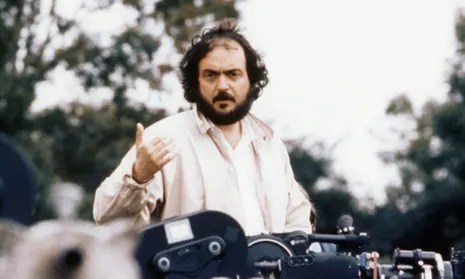
Darkness looms over the filmography of Stanley Kubrick. From the spacecraft run by the murderous artificial intelligence; dystopian London seeking to eradicate ultraviolence; the ruins of Vietnam; the isolated Overlook Hotel; or the War Room of the Pentagon; Kubrick was willing to explore what terrified others and has led many to despair about the future of humanity. It is the human condition to desert our principles in order to survive.
However, it is worth noting that, bleak as his movies may be, they all have some kind of happy ending. It may not be the traditional “and they lived happily ever after” that we seek, as an audience, but there is a form of relief to the conflict the protagonists must resolve.
In Paths of Glory (1954), the French soldiers are able to preserve their humanity, despite being commanded by officers who have given up theirs.
In Dr. Strangelove (1964), a nuclear holocaust breaks out, but the title character reveals that humanity can survive the coming apocalypse by living in mine shafts and repopulating the human race with ten beautiful women for each man (who must be a top government or military official).

In 2001: A Space Odyssey (1968), Dave defeats HAL 9000, the AI of their spacecraft, and travels beyond the known cosmos and transcends into humanity’s next form.

In A Clockwork Orange (1971), after his exposure to the Ludovico Technique leads to an attempted suicide, the government reconditions Alex’s brain from experiencing illness upon hearing Beethoven to erotic arousal.

In The Shining (1980), although Jack becomes fully possessed by the Overlook Hotel and attempts to murder his wife, Wendy, and son, Danny; the latter are able to escape to safety.

In Full Metal Jacket (1987), after killing a young enemy combatant, Joker narrates that, despite being “in a world of shit”, he is no longer afraid.

While it may be easy to believe that Kubrick believed that humanity was bad, I have come to believe that his films are ultimately optimistic, despite his films ending questionably worse-off than when the film began. These endings are a fortunate escape from the horrific experiences that they endured during the narrative. Could we consider these to be examples of Deus Ex? Could Kubrick be pretending to be the God that we all seek to save us from our trials? So often, God is silent, so is Kubrick his own version of God who grants us relief when we most need it?
Or could I simply be overthinking it and see something that simply is not there? But even overthinking is a sign that the filmmaker has left a proper impact on audiences. It does not matter if the hypotheses have no merit. When the audience continues to discuss a movie long after it has been released, the people behind the camera have succeeded.
 The City of Cinema